


How to Optimize Mixing Machines for Pharmaceutical Manufacturing
You can improve product quality and efficiency by optimizing mixing machines in pharmaceutical manufacturing. Rapid advances in smart automation and hygienic designs make these machines more reliable.
| Evidence Description | Impact on Operational Efficiency |
|---|---|
| Automation and smart monitoring | Boosts productivity and reduces downtime |
| Eco-friendly mixers | Cuts energy use and waste |
Key Factors Influencing Mixing Machines Optimization
Material Properties
You need to understand the properties of your materials before you start mixing. Particle size, density, and flowability all affect how well your ingredients blend. If you work with powders that have different sizes or densities, you may see uneven mixing. You can improve results by choosing the right mixer and adjusting the speed or mixing time. Mixing Machines that handle a wide range of material properties help you achieve better product quality.
Batch Size Considerations
Batch size plays a big role in how your mixing machines perform. You can see the impact of batch size in both batch and continuous processes:
| Aspect | Batch Process Impact | Continuous Process Impact |
|---|---|---|
| Material Properties | Significant impact on blending performance | More robust, resulting in uniform blends |
| Parameters | Particle size, density, flowability | Less sensitive to variations in properties |
| Blend Homogeneity | Varies significantly with batch size | Maintains uniformity across various blends |
-
You should check content uniformity by sampling from different spots in the batch.
-
You need to test active ingredient homogeneity at each batch size.
-
You can verify in-vitro performance with dissolution testing, which depends on batch size.
Process Requirements
You must follow strict process requirements to optimize mixing machines in pharmaceutical manufacturing.
-
Maintaining cleanliness keeps your products safe and free from contamination.
-
Process control ensures you meet cGMP regulations for quality and purity.
-
Selecting the right equipment and skilled operators improves efficiency and precision.
Tip: Regularly review your process requirements to keep your mixing operations efficient and compliant.
Comparing Common Mixing Machines Types
Double Cone Mixers
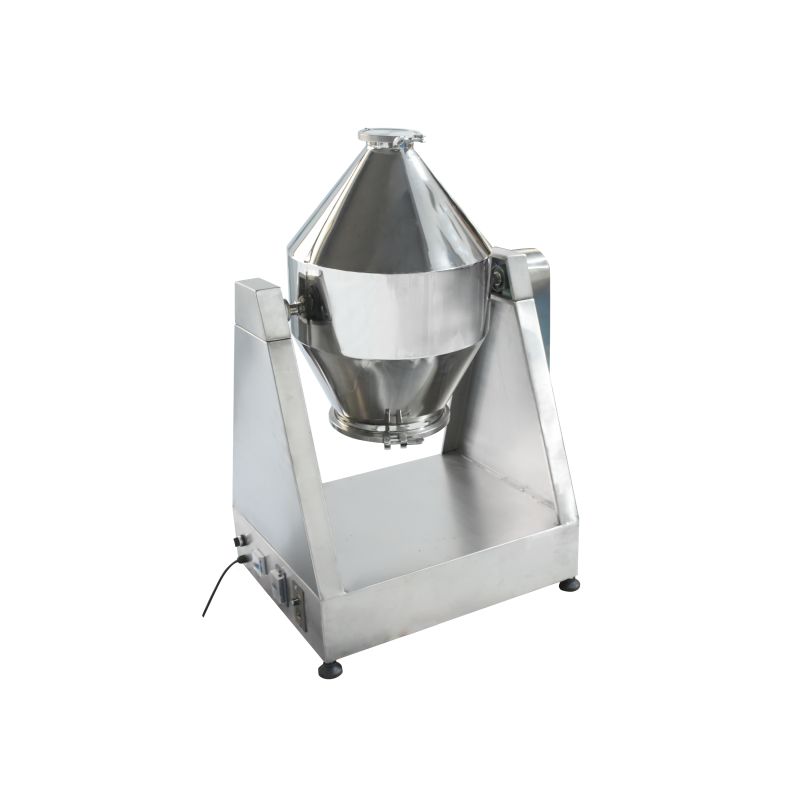
Double cone mixers help you blend dry powders and granules without adding heat or shear. Their unique shape creates a cascading motion, which helps all particles mix well. You can use these mixers for both free-flowing and sticky powders. They work fast and keep the mixture even, which is important for safe medicines.
| Advantages | Disadvantages |
|---|---|
| Consistent blending | Needs manual loading and unloading |
| Few dead zones | Takes up a lot of space |
| Fast and versatile | Hard to move due to heavy build |
| Precise control systems | Risk of ingredient separation after mixing |
| Good for many materials | High cost to install |
| Keeps particle size even | Limited control over mixing strength |
Tip: Double cone mixers help you save time and keep your product quality high.
Ribbon Mixers
Ribbon Mixers use a U-shaped trough and a rotating ribbon to mix powders and granules. You can achieve high homogeneity in a short time, especially if you use smaller particles and preblend your ingredients. These mixers give you consistent results from batch to batch, which helps you meet strict rules.
-
Ribbon mixers work well for dry powders.
-
You can finish mixing in 5 to 15 minutes.
-
The dual-direction ribbons prevent dead spots.
V-Type Mixers
V-type mixers, or V-blenders, have a V-shaped design that lets materials flow smoothly. You can use them for dry powders and granules, making sure all parts of your mix are even. These mixers are great for high-volume blending, which is important for making tablets and capsules.
-
You can mix active ingredients and fillers evenly.
-
V-type mixers help you meet quality standards for medicines.
Planetary Mixers
Planetary mixers use a special motion to blend thick or sticky materials. You can rely on them for creams, gels, and other high-viscosity products. These mixers improve your process speed and help you make high-quality products every time.
| Key Performance Metric | Description |
|---|---|
| Enhanced Mixing Capabilities | Mixes many types of formulas well |
| Improved Process Efficiency | Saves time and resources |
| Enhanced Product Quality | Keeps products consistent |
| Cost-Effective Production | Reduces need for extra equipment |
| Enhanced Regulatory Compliance | Meets strict rules for medicine production |
High Shear Mixers
High shear mixers create strong turbulence, breaking down ingredients into tiny droplets. You can use them to make creams, gels, and suspensions. These mixers help you get even dispersions, which means every dose has the right amount of medicine.
-
High shear mixers prevent clumps and waste.
-
They make products more stable and last longer.
-
You can clean them quickly between batches.
Conical Screw Mixers
Conical screw mixers use a screw inside a cone to blend materials gently. You can mix fragile powders without breaking them. These mixers keep your products safe from contamination and reduce the need for manual work.
| Benefit | Description |
|---|---|
| Increased Mixing Efficiency | Blends materials thoroughly |
| Enhanced Product Quality | Gentle mixing keeps powders safe |
| Versatility in Application | Works for many industries, including medicines |
| Reduced Labor Costs | Less manual work needed |
| Improved Safety and Hygiene | Enclosed design keeps products clean |
Mixing machines come in many types, each with special features to help you make safe and effective medicines.
Selecting the Right Mixing Machines Equipment
Matching Mixer to Application
You need to match the right mixer to your specific pharmaceutical process. Each application has unique needs. The table below shows important criteria you should consider:
| Criteria | Description |
|---|---|
| Material Properties | Affects the choice of mixers based on viscosity and density, influencing the power needed for mixing. |
| Chemical Compatibility | Ensures no adverse reactions occur between materials and equipment, preventing contamination. |
| Consistency Desired | Refers to achieving uniform distribution among components, crucial for effective mixing. |
| Particle Size Distribution | Smaller particles mix more easily; equipment must handle desired sizes effectively. |
| Production Scale | Determines whether batch or continuous processing is suitable based on quantity. |
| Equipment Capacity | Must align with production requirements to ensure operational efficiency. |
Tip: Always check if your mixer can handle the material and batch size you plan to use.
Evaluating Equipment Features
You should look at the features that help mixing machines perform well. Homogenizers and blenders play a big role in making sure your ingredients mix evenly. High pressure in homogenizers helps create stable and smooth products. This even mixing is important for making sure every dose of medicine works the same way. Reliable equipment helps you meet quality standards and keeps your products safe.
Cost and Maintenance Factors
You must think about cost and maintenance before you choose a mixer. Some machines cost more at first but save money over time because they need less repair. Easy-to-clean designs help you avoid long downtimes. Regular maintenance keeps your equipment running and your products safe. You should also check if spare parts are easy to get.
Practical Strategies for Optimizing Mixing Machines Performance
Adjusting Process Parameters
You can improve your mixing results by adjusting process parameters. These settings help you control how well your ingredients blend. The table below shows important parameters you should monitor and adjust:
| Process Parameter | Description |
|---|---|
| Impeller Speed | The rotational speed of the impeller can be adjusted to enhance mixing efficiency. |
| Initial Loading Pattern | The way materials are loaded into the mixer can affect the blending process and outcomes. |
| Mixing Blade Design | Different designs and angles of mixing blades can be optimized for better blending performance. |
| Real-time Monitoring | Techniques like Near Infrared (NIR) Spectroscopy are used to assess blend homogeneity in real-time. |
You should pay close attention to blending speed and mixing time. These factors have a big impact on product quality. The table below shows how different speeds and times affect blend uniformity:
| Blending Speed | Number of Revolutions | RSD Values | Blend Uniformity |
|---|---|---|---|
| Low | 90 | Above 5% | Poor |
| High | 750 | Below 5% | Uniform |
| Low | 80 | Not close to 100% | Poor blending performance |
| High | Various | Below 5% | Uniform for all grades |
You can achieve better results by using higher speeds and more revolutions. Real-time monitoring tools, such as NIR spectroscopy, help you check blend quality during the process. This allows you to make quick adjustments and avoid mistakes.
Tip: Start with small changes to process parameters and observe the results. This helps you find the best settings for your mixing machines.
Routine Maintenance and Cleaning
You need to keep your mixing machines in good condition to ensure safe and effective production. Regular maintenance prevents breakdowns and keeps your equipment running smoothly. The table below shows recommended maintenance schedules based on how often you use your mixers:
| Maintenance Frequency | Type of Mixer | Usage Level |
|---|---|---|
| Quarterly | Standard Mixers | High |
| Biannually | Standard Mixers | Medium |
| Annually | Standard Mixers | Low |
| More Frequent | Critical Components | N/A |
You should clean your equipment after each batch to prevent contamination. Always check for worn parts and replace them as needed. Keeping a maintenance log helps you track repairs and cleaning activities.
Note: Well-maintained mixing machines reduce downtime and improve product quality.
Validation and Documentation
You must validate your mixing machines to meet industry standards. Validation proves that your equipment works as expected and produces safe medicines. The process includes three main stages:
| Stage | Description |
|---|---|
| Installation Qualification (IQ) | Verifies that the equipment is installed correctly according to specifications and standards. |
| Operational Qualification (OQ) | Tests the equipment to ensure it operates according to predefined operational specifications. |
| Performance Qualification (PQ) | Tests the equipment under real-world conditions to ensure consistent performance over time. |
You should keep thorough documentation for every step. Good records help you organize data and make it easy to find during audits. You can use knowledge graphs to improve data traceability and governance. Mapping your data to regulatory requirements keeps your documentation complete and up to date. This reduces the risk of non-compliance.
-
Organized records create a clear audit trail.
-
Traceable data supports regulatory reviews.
-
Up-to-date documentation lowers compliance risks.
Operator Training
You need well-trained operators to run mixing machines safely and efficiently. Many traditional training programs focus only on rules, not on real learning. You should give your team training that covers both procedures and the science behind mixing. This helps them understand why each step matters.
-
Use modern training tools, such as virtual reality (VR), to make learning more engaging.
-
Teach operators the basic principles of mixing, not just the steps.
-
Update training programs regularly to include new technology and best practices.
Tip: Investing in better training leads to fewer mistakes and higher product quality.
Ensuring Compliance and Quality Control with Mixing Machines
Meeting Regulatory Standards
You must follow strict rules when you use mixing machines in pharmaceutical manufacturing. The FDA and 3-A standards set clear requirements for equipment design. These standards help you prevent cross-contamination and keep your products safe. You need to make sure your machines meet sanitary guidelines. Clean surfaces and proper seals stop germs and dust from getting into your medicine.
Facilities and equipment play a big role in meeting CGMP rules. You should inspect and maintain your machines often. Regular checks help you find problems early and keep your process running smoothly. You must train your staff in CGMP standards. Ongoing training helps everyone know the right steps and keeps your team ready for audits.
| Aspect | Description |
|---|---|
| Quality Assurance (QA) | Proactive approach to prevent errors through adequate processes. |
| Personnel Training | Ensures staff are qualified and regularly assessed for competency. |
| Equipment Maintenance | Regular servicing and calibration of mixing machines to ensure compliance. |
| Documentation | Detailed records and SOPs for traceability and accountability. |
| Quality Control (QC) | Reactive testing of materials and products to detect defects. |
| Self-Inspection and Audits | Regular internal audits to ensure compliance and identify areas for improvement. |
Tip: Keep detailed records and test your machines often. This helps you stay ready for inspections.
Quality Assurance Practices
You can use several quality assurance practices to monitor your mixing machines. Quality Management Maturity (QMM) helps you improve delivery and performance. Statistical Process Control (SPC) lets you track and fix problems quickly. Training in Quality Risk Management (QRM) helps your team make smart choices. Corrective and Preventive Actions (CAPA) stop mistakes from happening again. The 5S method keeps your workspace clean and organized.
| Quality Assurance Practice | Description |
|---|---|
| Quality Management Maturity (QMM) | Establishments implementing QMM elements showed significant improvement in Delivery KPI. Higher implementation correlates with better performance. |
| Statistical Process Control (SPC) | Utilizes statistical techniques to control processes, improving delivery performance by identifying and eliminating variations. |
| Quality Risk Management (QRM) Training | Proper training ensures employees apply QRM outcomes effectively, leading to higher quality standards. |
| Corrective and Preventive Actions (CAPA) | An effective CAPA system helps in root cause determination and prevents recurrence, enhancing understanding of processes. |
| 5S Procedures | High implementation of 5S ensures organized work environments, preventing bottlenecks and maintaining equipment. |
You should choose equipment that matches the thickness, size, and chemical makeup of your materials. Adjust mixing settings to get the best results. Proper mixing helps you spread active ingredients evenly. You can test your batches to check for uniformity and quality.
Note: Good quality assurance keeps your products safe and helps you meet all rules.
You can optimize mixing machines by selecting the right equipment, focusing on flexibility, and using advanced features like in-place cleaning and automation.
Continuous improvement leads to better efficiency and helps you meet strict regulations.
| Feature | Benefit |
|---|---|
| Variable speed controls | Optimizes mixing processes |
| Enclosed systems | Prevents dust contamination |
FAQ
What is the most important factor when choosing a mixing machine?
You should focus on your material properties. Particle size, density, and flowability affect how well your ingredients blend.
How often should you clean pharmaceutical mixing machines?
You need to clean your mixing machines after every batch. This step helps prevent contamination and keeps your products safe.
Can automation improve mixing machine performance?
Yes! Automation lets you monitor processes in real time. You can adjust settings quickly and reduce human error.